GEO Score: Optimize for AI Search Engines
40+ research-backed factors across 7 categories measure how well your content is optimized for citations in ChatGPT, Perplexity, and Google AI Overviews. The first scoring system of its kind in a WordPress plugin.
SEO Alone Is No Longer Enough
AI-referred traffic surged 527% in the first half of 2025. Google AI Overviews now reach over 2 billion monthly users. ChatGPT handles 800 million weekly searches. And 93.7% of AI Overview citations come from pages outside the traditional top 10 rankings.
Traditional SEO optimizes for Google's blue links. GEO (Generative Engine Optimization) optimizes for the AI engines that are rapidly replacing them. If your content isn't structured for AI extraction, you're invisible to a growing share of searchers.
SEObolt's GEO Score tells you exactly what to fix and provides specific, actionable recommendations backed by peer-reviewed research.
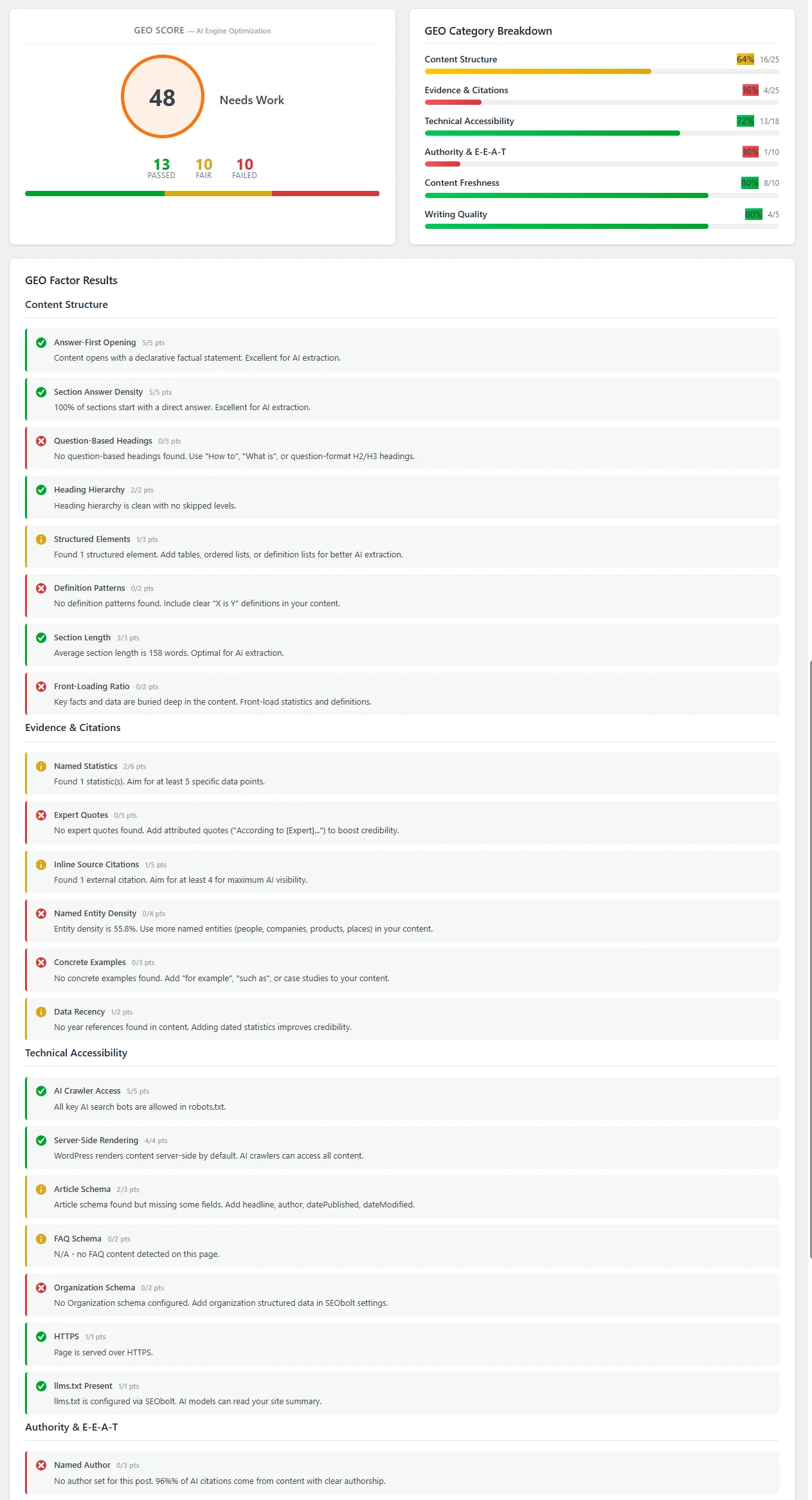
GEO Score ranges from 0-100. Green means AI engines can easily extract and cite your content. Yellow means there are improvements to make. Red means critical issues are blocking AI visibility and your content is effectively invisible to AI search.
What GEO Score Measures
Every factor is based on published research from Princeton, Georgia Tech, UC Berkeley, Ahrefs, and BrightEdge. Not guesswork, but data. Each category produces its own sub-score, so you can see exactly which area of your content needs attention for AI visibility.
Content Structure
10 factorsAI engines extract content in chunks. Structure determines what gets cited.
- Answer-first opening
- Answer density on question-shaped headings
- Chunk fitness (RAG-optimal paragraph length)
- Question-based headings
- Heading hierarchy
- Structured elements (tables, lists)
- Definition patterns & front-loading
Evidence & Citations
7 factorsAdding statistics boosts AI visibility by +40%. Inline citations increase AI selection rate by 10.9x.
- Named statistics
- Expert quotes
- Inline source citations
- Named entity density
- Concrete examples & data recency
- Claim-check-friendly facts (adjacent citations)
Technical Accessibility
3 factors73% of websites have technical barriers blocking AI crawlers. These factors check if AI can even reach your content.
- AI crawler access (robots.txt)
- Server-side rendering (SSR)
- HTTPS
- Schema markup + llms.txt reported diagnostically (routing signals for AI agents, not currently a scored ranking factor)
Authority & E-E-A-T
4 factors96% of AI Overview citations come from sources with strong E-E-A-T signals.
- Named author
- Author entity verification (Person schema + sameAs to Wikidata, LinkedIn, ORCID, GitHub, Mastodon, Threads)
- Experience markers
- Organization signals
Content Freshness
4 factorsFresh content gets 3.2x more citations from Perplexity. Stale data is a citation killer.
- Last modified recency
- Visible publish date
- No stale data references
- Update cadence
Writing Quality
5 factorsAI engines prefer declarative, non-promotional writing with clear readability.
- Declarative tone
- No promotional language
- Keyword-stuffing penalty
- Readability (Flesch score)
- Paragraph length
Off-Site Brand Signals New in v3
3 factorsBranded mentions correlate 3× stronger than backlinks with AI Overview visibility. Fetched from your SEObolt Dashboard.
- Brand search volume trend (Google Search Console)
- Wikipedia article presence
- YouTube brand mentions Business+
Critical Blockers That Cap Your Score
Before scoring your content, GEO Score checks three eligibility gates. If any gate fails, your score is hard-capped, meaning no amount of great content can overcome a technical blocker.
HTTPS Required
Score capped if your page is not served over HTTPS. AI engines will not cite insecure content.
AI Crawler Access
Score capped if robots.txt blocks AI crawlers (OAI-SearchBot, ChatGPT-User, PerplexityBot, Googlebot).
Server-Side Rendering
Score capped if content requires JavaScript to render. WordPress sites auto-pass this gate.
GEO Score Across Your Entire Workflow
GEO Score is not a standalone tool buried in a submenu. It appears everywhere you work with content in SEObolt.
- Post Editor Sidebar: GEO Score tab in the SEObolt meta box shows your score and per-factor breakdown as you write.
- SEO Analysis Page: Full GEO breakdown with category scores, factor results, and gate warnings on the standalone analysis page.
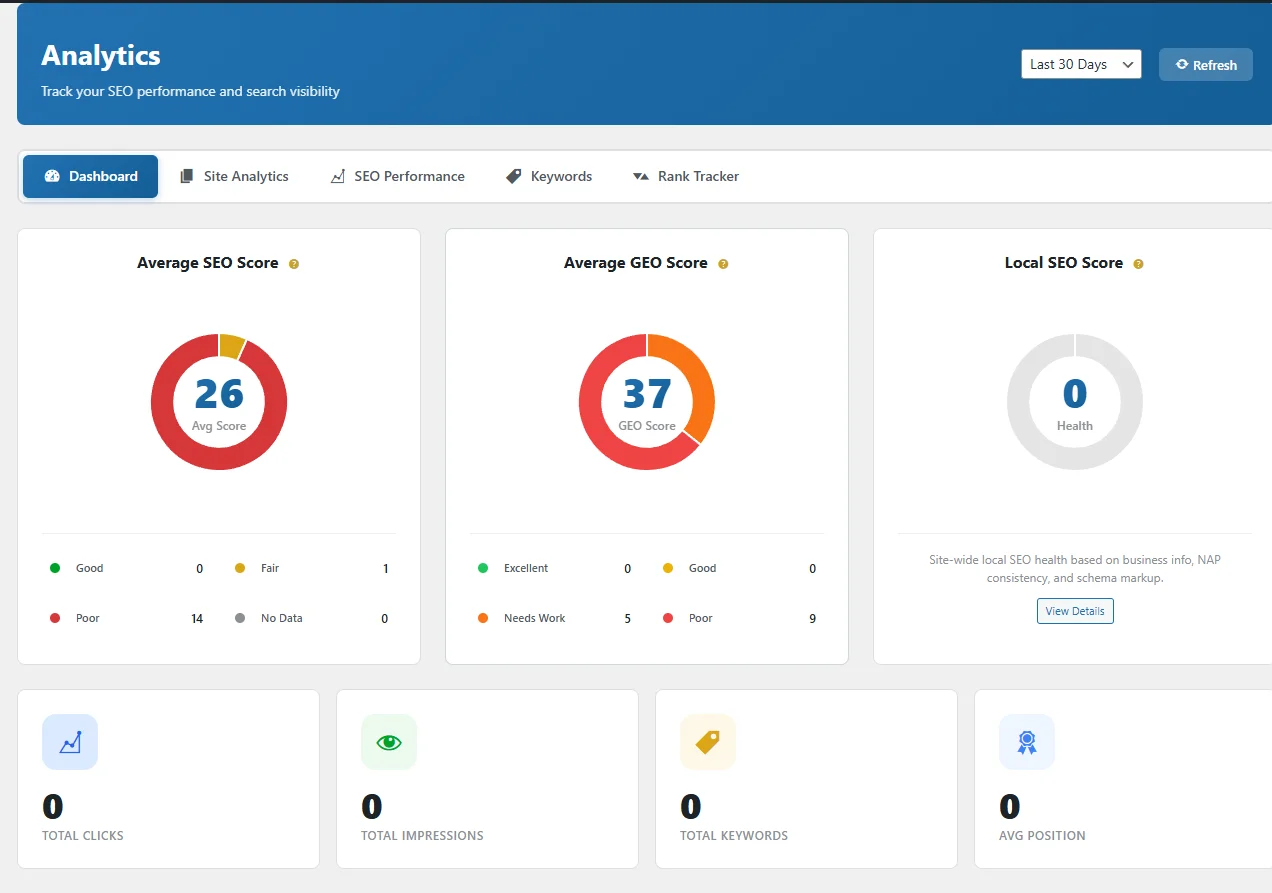
- Analytics Dashboard: Average GEO Score donut chart alongside your SEO Score and Schema Score.
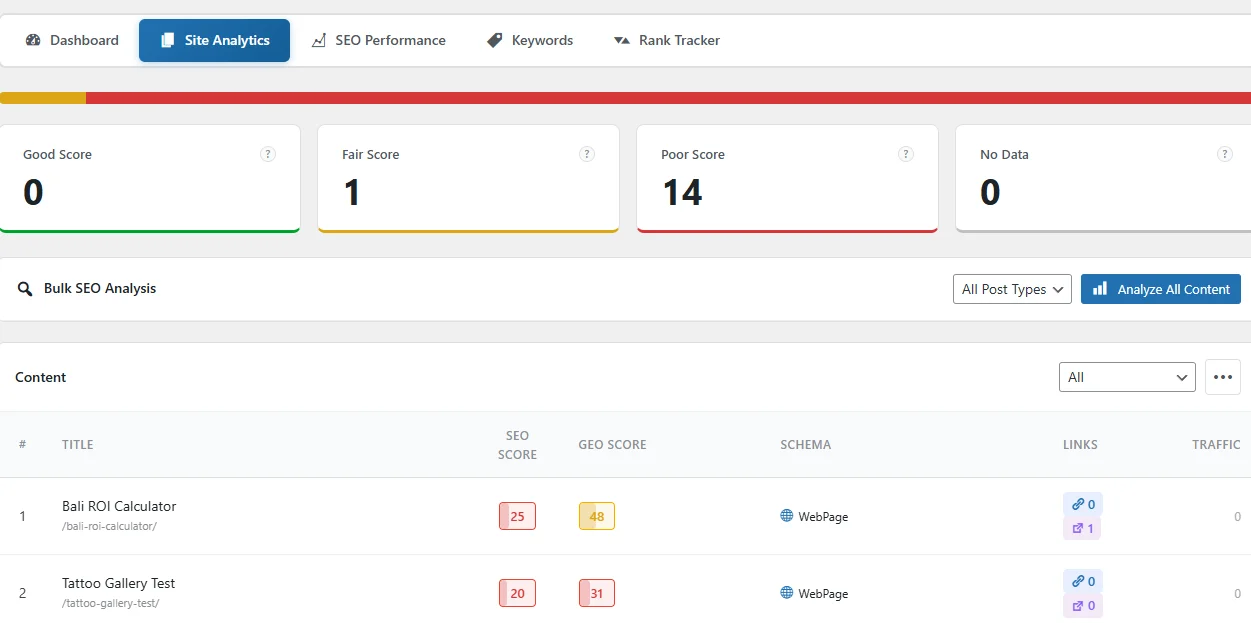
- Site Analytics Table: GEO Score column with filtering by Good (75+), Fair (40-74), or Poor (<40) to find pages that need optimization.
- Admin Bar: GEO Score badge visible on the frontend alongside your SEO Score.
GEO Score + LLM Rankings: The Complete AI Visibility Stack
GEO Score tells you what to fix. LLM Rankings tells you if it worked. Together, they form the only AI visibility optimization loop available in a WordPress plugin.
- GEO Score: Analyze any page across 40+ factors. Get a score, see what is weak, follow the recommendations.
- LLM Rankings: Track whether ChatGPT, Claude, Perplexity, Gemini, and DeepSeek mention your brand and pages. Monitor changes over time.
- Closed Loop: Improve your GEO Score, then check LLM Rankings to see if your AI citations increased. Iterate until you dominate.
No other WordPress plugin offers both. Standalone GEO tools charge $99-199/month. SEObolt includes it starting at $149/year with the full SEO suite.
| Feature | SEObolt Pro | Rank Math | Yoast |
|---|---|---|---|
| GEO Score (AI optimization) | 40+ factors | No | No |
| LLM Rankings (AI visibility) | ChatGPT, Claude, Perplexity, Gemini, DeepSeek | No | No |
| Content Signals Editor | Service / Ecommerce / Publisher presets | No | No |
| llms.txt Editor | Full editor + auto-generation | Basic | No |
| 404 Recovery Block for AI Agents | Semantic recovery aside | No | No |
| Research-Backed Scoring | Princeton, Georgia Tech | No | No |
* Research basis for GEO Score: Aggarwal, Murahari, Rajpurohit, Kalyan, Narasimhan, & Deshpande, “GEO: Generative Engine Optimization” (Princeton, Georgia Tech, et al., KDD 2024, arXiv:2311.09735); along with additional published work on AI citation behavior and source-attribution in large language models. SEObolt’s 40+ factor weights combine these findings with internal benchmark studies across ChatGPT, Perplexity, Claude, Gemini, and Google AI Overviews citation samples.
Start Optimizing Every Page
Get the 57-point analysis engine, unlimited focus keywords, and all other SEObolt Pro features with a single license.