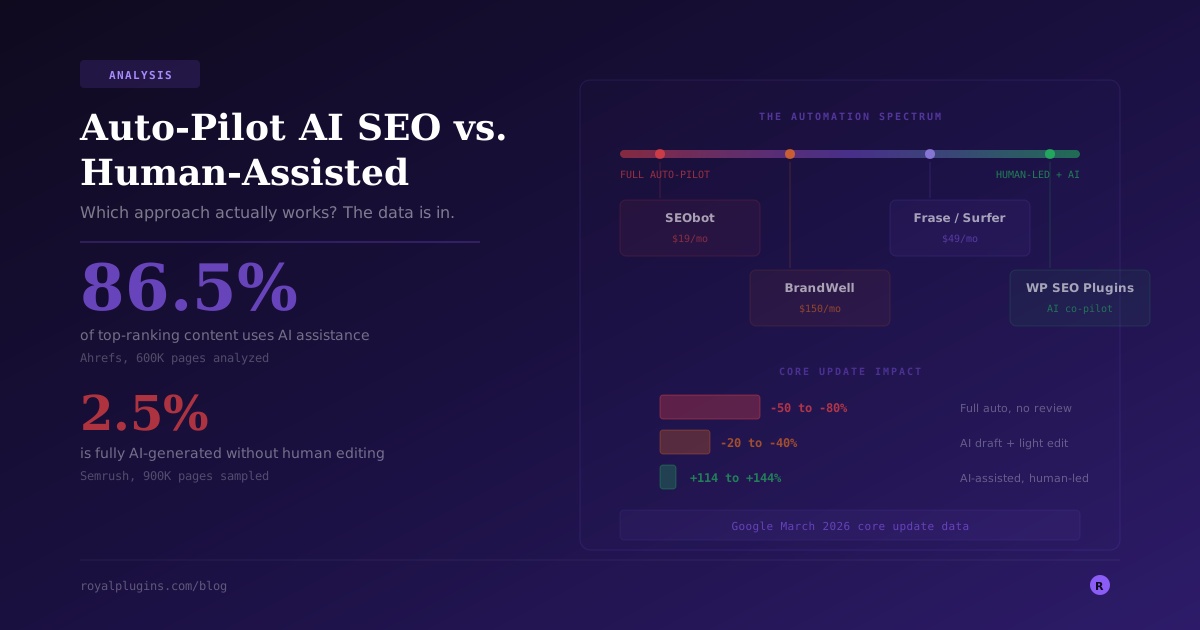
Auto-pilot AI SEO tools (SEObot, Byword, Ranklytics, BrandWell) write and auto-publish content without human review. Human-assisted tools (Frase, Surfer, SEObolt) use AI as a draft layer under editorial oversight. Google does not penalize AI content. It penalizes scaled content abuse. Every documented success story involves human oversight; every mass penalty involves its absence.
Every SEO tool in 2026 claims to be “AI-powered.” But the spectrum is enormous. On one end, tools like SEObot and Byword will research keywords, write articles, and publish them to your site while you sleep. On the other end, tools use AI to suggest titles or expand a paragraph. A human makes every decision.
Both approaches have real trade-offs, and the data on what actually works is starting to come in. This article breaks down the landscape, examines Google’s stance, and looks at what the numbers say about each approach.
The Auto-Pilot AI SEO Landscape
A new category of tools has emerged that automate the entire SEO content pipeline (from keyword research to publishing) with minimal or zero human involvement. Here are the major players:
Full Auto-Pilot (Set and Forget)
SEObot ($19–49/mo) automates keyword research, article generation (up to 4,000 words with images), internal linking, and auto-publishing to WordPress, Webflow, and Shopify. It supports 50 languages and claims over 100,000 articles generated.
Byword specializes in programmatic SEO: generating hundreds or thousands of articles from keyword lists in bulk. It supports GPT, Claude, and Gemini models and auto-publishes to multiple CMSs. Over 85,000 content teams reportedly use it.
Ranklytics Autopilot handles the entire workflow from a single input: your website URL or niche. It researches keywords, builds a content strategy, writes, optimizes, links, publishes, and tracks rankings. All automatically.
Near-Auto-Pilot (Heavy Automation, Light Oversight)
BrandWell (formerly Content at Scale, $150–499/mo) generates 2,500+ word SEO-optimized articles from a single keyword, complete with title, meta description, internal links, and table of contents. Not fully auto-publish, but near-zero intervention per article.
OTTO SEO by Search Atlas ($99–999/mo) takes a different angle: autonomous technical SEO remediation. It deploys fixes directly to your site (rewriting title tags, updating meta descriptions, adding schema markup, and restructuring internal links) without manual implementation.
Frase ($49–299/mo) covers all six SEO pipeline stages: research, strategy, write, audit, monitor, and fix. Its “Content Watchdog” detects ranking drops and autonomously generates content fixes. It also tracks AI search visibility across 8 LLM platforms.
Auto-pilot SEO ranges from $19/month (SEObot) to $999/month (Search Atlas Agency). The price difference reflects the scope: content-only generation at the low end, full technical SEO automation at the high end.
What Google Actually Says About AI Content
Google does not ban AI-generated content. Their official position, consistent since February 2023:
“Appropriate use of AI or automation is not against our guidelines. It is not used to generate content primarily to manipulate search rankings.”
— Google Search Central, “Google Search’s guidance about AI-generated content” (Feb 2023)
The red line is what Google calls scaled content abuse: publishing large volumes of pages “for the primary purpose of manipulating search rankings and not helping users.” This applies regardless of whether the content was written by AI, generated from templates, or scraped.
What Triggers Penalties
- Publishing hundreds or thousands of pages without editorial oversight
- Content with little originality or added value beyond what already exists
- Identical structure across pages (a telltale sign of programmatic generation)
- No original research, data, or subject-matter expertise
- Generic content covering topics that are already well-covered
Recent Core Update Impact
The March 2026 core update explicitly named scaled content abuse as a primary target. Sites with hundreds of AI-generated pages published without oversight saw 50–80% traffic drops. One documented case (Izoate.com) lost 89% of its traffic in a single update cycle. Affiliate review sites using AI-generated product comparisons saw 40–70% traffic losses for lacking expertise and original data.
Every documented mass penalty shares the same trait: high volume, low oversight. Sites that published 500+ AI pages in bulk without editorial review were hit hardest. Sites using AI with human editing were largely unaffected.
What the Data Actually Shows
Two large-scale studies give us the clearest picture of how AI content performs in search:
The Ahrefs 600K-Page Study
Ahrefs analyzed 600,000 pages and found that 86.5% of top-ranking content uses some form of AI assistance. The correlation between AI-generated content and ranking penalties was near-zero (0.011). In other words: using AI doesn’t hurt you. How you use it determines the outcome.
The Semrush 900K-Page Sample
Semrush sampled 900,000 pages and found that 74.2% of new web pages contain AI-generated content. But only 2.5% are fully AI-generated without human editing. The vast majority of AI content goes through at least one round of human review before publishing.
The Success Stories
Every documented success story with AI content shares one common factor: human oversight was present. The pattern is consistent:
- AI generates a draft
- A human adds expertise, original data, and brand voice
- AI optimizes and suggests improvements
- A human approves and publishes
Businesses using this hybrid approach reported 114–144% organic traffic increases within 180 days. One agency documented 4,162% organic traffic growth using AI-driven SEO. But with human strategy and oversight at every stage.
The Failure Pattern
The cases where traffic collapsed (50–80% drops) were sites that used AI as a pure content factory. No editorial review, no original expertise, no differentiation from what already existed in search results. The content was technically correct but added nothing new.
| Approach | Typical Result | Risk Level |
|---|---|---|
| Full auto-pilot, no review | Short-term gains, 50–80% drops on core updates | High |
| AI draft + light human editing | Moderate gains, some vulnerability to updates | Medium |
| AI-assisted, human-led | 114–144% traffic growth in 180 days | Low |
| Fully manual (no AI) | Slower output, but immune to AI-specific penalties | Low |
The Automation Spectrum: Where Each Tool Sits
It’s not binary. These tools sit on a spectrum from “fully autonomous” to “AI as a co-pilot.”
| Tool | Automation Level | Human Role |
|---|---|---|
| SEObot, Byword, Ranklytics | Full auto-pilot | Set niche/keywords, walk away |
| BrandWell | Near auto-pilot | Input keyword, review output, publish |
| OTTO SEO | Auto-pilot (technical only) | Review deployed fixes |
| Frase, Surfer | Heavy assist | Human writes with AI optimization |
| WordPress SEO plugins (Rank Math, Yoast, SEObolt, etc.) | AI co-pilot | Human creates content, AI suggests improvements |
The further right on the spectrum (toward human involvement), the lower the risk and the more durable the results. The further left (toward full automation), the faster the output but the higher the exposure to algorithm updates.
When Each Approach Makes Sense
Auto-Pilot Can Work For
- Commodity informational content: generic how-to pages, simple definitions, and basic reference material where the bar for quality is low and volume matters
- Programmatic SEO at scale: location pages, product variations, and template-driven content where the structure is fixed and the data changes
- Early-stage sites that need to build topical coverage quickly and will layer in human expertise later
Human-Assisted AI Is Better For
- YMYL content (Your Money or Your Life): health, finance, legal, and other topics where Google holds content to a higher E-E-A-T standard
- Competitive niches where dozens of articles already exist and only original insight, data, or perspective can differentiate you
- Brand-building content: thought leadership, case studies, and opinion pieces that require a distinct voice
- Content in regulated industries where factual accuracy has legal or compliance implications
Ask: “Would I be comfortable putting my name on this article without reading it first?” If the answer is no, full auto-pilot is the wrong approach for that content type.
The New Variable: AI Search Engines
There’s a dimension that most auto-pilot tools haven’t caught up with yet: Generative Engine Optimization (GEO). ChatGPT, Perplexity, Gemini, and Claude now answer billions of search queries, and they cite sources differently than Google.
Research from Princeton and Georgia Tech found that specific content attributes (statistics, expert quotes, structured data, and cited sources) increase AI citation rates by 30–40%. These are exactly the attributes that require human expertise to add convincingly.
Most auto-pilot tools optimize for traditional Google rankings but don’t account for how AI answer engines select and cite sources. As AI search grows (early 2026 data shows AI search visitors convert 16% better than non-AI traffic), this gap may widen.
The Bottom Line
AI SEO tools are not going away, and they shouldn’t. 89% of SEO teams are using AI tooling in 2026 and it makes workflows measurably faster (47% faster content production on average).
But the data is clear on one point: the sites that thrive use AI to accelerate human expertise, not replace it. The 86.5% of top-ranking content that uses AI assistance is not auto-piloted. It’s human-led with AI augmenting specific tasks.
The 2.5% of content that is fully AI-generated without editing is disproportionately represented in the sites that lost 50–80% of their traffic during 2025–2026 core updates.
The lowest-risk, highest-return approach remains: use AI to draft, suggest, optimize, and expand. Keep a human making the strategic decisions, adding the expertise, and pressing the publish button.