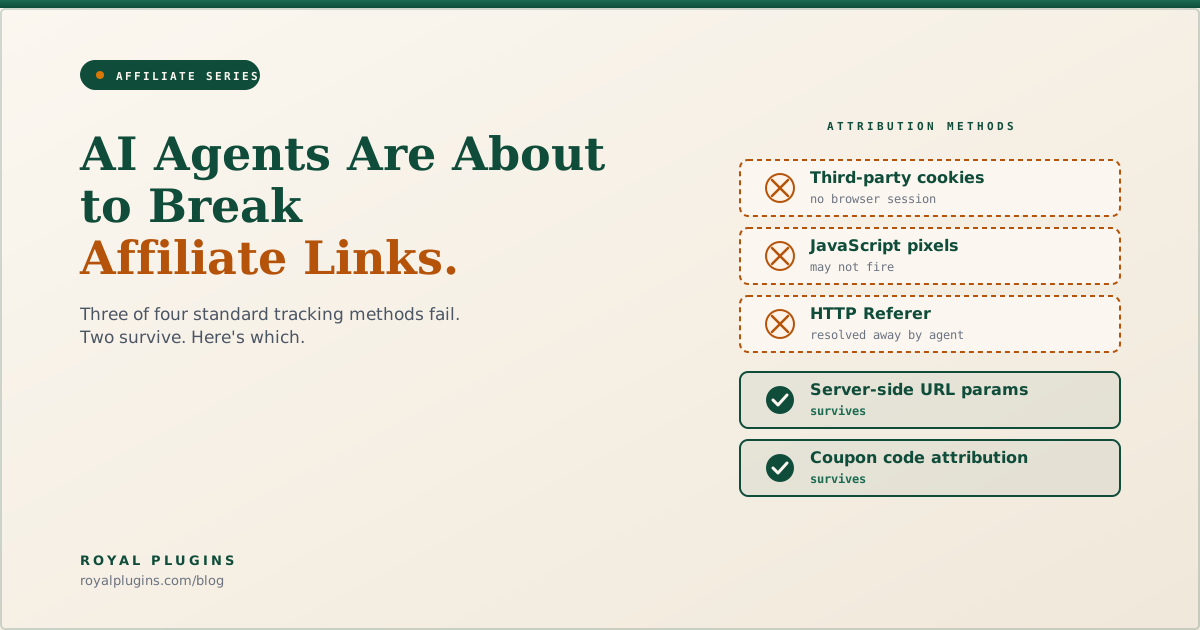
OpenAI Operator launched in January 2025 and was rolled into ChatGPT agent in July 2025. Anthropic's Computer Use shipped in October 2024 and is still active. Perplexity Shopping bypasses traditional checkout entirely. When an AI agent makes a purchase on a user's behalf, three of the four standard affiliate tracking methods fail: third-party cookies, JavaScript pixels, and HTTP Referer headers. The two that survive are server-side URL parameter tracking and coupon code attribution. Most WordPress affiliate plugins treat both as afterthoughts.
The first wave of agentic commerce is already shipping. Most WordPress affiliate programs are still tracking traffic the way they did in 2018. That gap is about to matter.
The Agentic Commerce Era Is Already Here
Five products that can complete a purchase without a human clicking a button:
- OpenAI Operator → ChatGPT agent (Operator launched January 2025, deprecated August 31, 2025; capabilities folded into ChatGPT agent on July 17, 2025): a virtual browser environment that browses sites, fills forms, and completes transactions on instruction.
- Anthropic Computer Use (October 2024): Claude controls a desktop environment, including web browsers, and can drive checkout flows end-to-end.
- Perplexity Shopping with Buy with Pro (November 2024): embedded checkout inside the answer panel, often through direct merchant integrations that route around affiliate networks.
- Google Gemini agent demos (I/O 2024 and 2025): hands-off shopping research and ticket purchasing previewed as core platform capabilities.
- Stripe's Agentic Commerce Protocol (2025): payment infrastructure designed for agents acting on behalf of users, including new transaction-source labels.
This isn't a 2027 problem. Agents are buying things right now, and the infrastructure assumes they'll be buying more by Q4 2026.
Why Cookie-Based Attribution Fails for Agents
Every WordPress affiliate plugin built before 2024 leans on the same primary mechanism: a cookie set in the user's browser when they click the affiliate link, read again when checkout completes. That mechanism has four failure modes in agent contexts.
Headless and virtual browsers carry no user cookies. ChatGPT agent (and the original Operator before it) runs in OpenAI's infrastructure, not the user's Chrome session. There's nothing to set the affiliate cookie in.
Agents clean URLs. When an agent reads "go buy this," it often resolves the destination URL, drops query strings it doesn't recognize, and navigates directly. Your ?ref= parameter goes with it.
JavaScript pixels don't always fire. Some agent contexts execute JS, some don't. Tracking pixels that depend on gtag() or affiliate-network JavaScript fail unpredictably.
HTTP Referer is unreliable. Agents often resolve through internal navigation, API calls, or third-party shopping platforms. The Referer header arriving at checkout may be the agent's own platform, not the affiliate's site.
The result: the affiliate sent the lead, the user bought the product, and nothing in the merchant's analytics knows the affiliate was involved.
What Actually Survives an Agent-Initiated Purchase
Three attribution methods still work reliably.
Server-side URL parameter tracking. If the affiliate ID rides in the URL all the way to checkout (and is captured server-side at every step, not just on first landing), it survives most agent flows. Even when the agent strips parameters mid-journey, a server that grabbed the ID on first hit can persist it via session, account, or hidden form field.
Coupon code attribution. When an affiliate publishes a discount code, that code travels with the user regardless of cookies, JavaScript, or Referer. The agent types the code at checkout, the program credits the affiliate. No tracking technology required.
Direct merchant integrations. When AI shopping platforms expose partner APIs (Perplexity has started doing this), affiliates can register through the platform and receive structured purchase events. This is early, but it's the model that scales.
Third-party cookies, JS pixels, and any single-touch attribution that depends on the user's browser carrying state. The methods that survive are the methods that never relied on the browser to begin with.
The User-Agent Identification Problem
Some AI traffic identifies itself in the User-Agent string. Anthropic publishes ClaudeBot, Claude-User, and Claude-SearchBot. OpenAI publishes GPTBot and ChatGPT-User. Perplexity publishes PerplexityBot and Perplexity-User.
Affiliates and program operators can log these on conversion events to flag agent-driven traffic, route it to a separate attribution bucket, and report on it cleanly.
The hard cases: ChatGPT agent and Computer Use often use the user's actual browser, with the user's actual User-Agent. There's no header that says "an agent drove this purchase." Detection has to come from behavioral signals, IP patterns, or merchant-side instrumentation that the agent platforms haven't built yet.
This is genuinely uncharted. There's no IETF standard for "agent-initiated transaction" headers. Stripe's Agentic Commerce Protocol is one early proposal. Visa and Mastercard have published thinking on agent transaction labels. Nothing is settled.
What This Means for WordPress Affiliate Programs
Three of the major WordPress affiliate plugins (AffiliateWP, SliceWP, Easy Affiliate) treat URL parameter tracking and coupon attribution as secondary layers. The cookie is the source of truth; everything else is a fallback for "broken" sessions.
In an agentic commerce world, that hierarchy inverts. Server-side and coupon-based attribution become the source of truth. Cookies become the fallback for the shrinking pool of human-only traffic.
Royal Affiliate Pro ships HTTP Referer attribution as a primary tracking method (server-side, cookie-independent), URL parameter tracking with persistent server-side capture, and coupon code attribution with a 7-level priority resolution system. The architecture matches what survives an agent purchase, not what survives a 2018 click.
That isn't a coincidence of timing. It's a deliberate bet that cookies are an inheritance from a different web.
What To Do This Week
If you run an affiliate program:
- Audit which of your tracking layers work without cookies. Most program operators don't actually know.
- Enable URL parameter tracking with persistent server-side capture, not browser-only state.
- Set up coupon code attribution rules with explicit priority resolution.
- Log the User-Agent string on every conversion event.
- Add an
agent_detectedflag to your analytics for known agent UAs.
If you're an affiliate:
- Make sure every campaign has a coupon code, not just a tracking link.
- Test your tracking with ChatGPT agent or Computer Use. Buy something through the agent and check whether you got credit.
- Ask your favorite programs whether they've added agent-aware attribution. The answer tells you which programs are paying attention.
The window for getting ahead of this is short. By the time agentic commerce is mainstream, the programs and affiliates that built for it will have already absorbed the volume.
Sources
- OpenAI Operator launch announcement (January 2025); ChatGPT agent rollout (July 2025); Operator deprecation (August 2025)
- Anthropic Computer Use launch announcement (October 2024)
- Perplexity Shopping launch (November 2024)
- Stripe Agentic Commerce Protocol announcements (2025)
- Anthropic published User-Agent list (Claude crawlers and user agents)
- OpenAI published User-Agent list (GPTBot, ChatGPT-User)