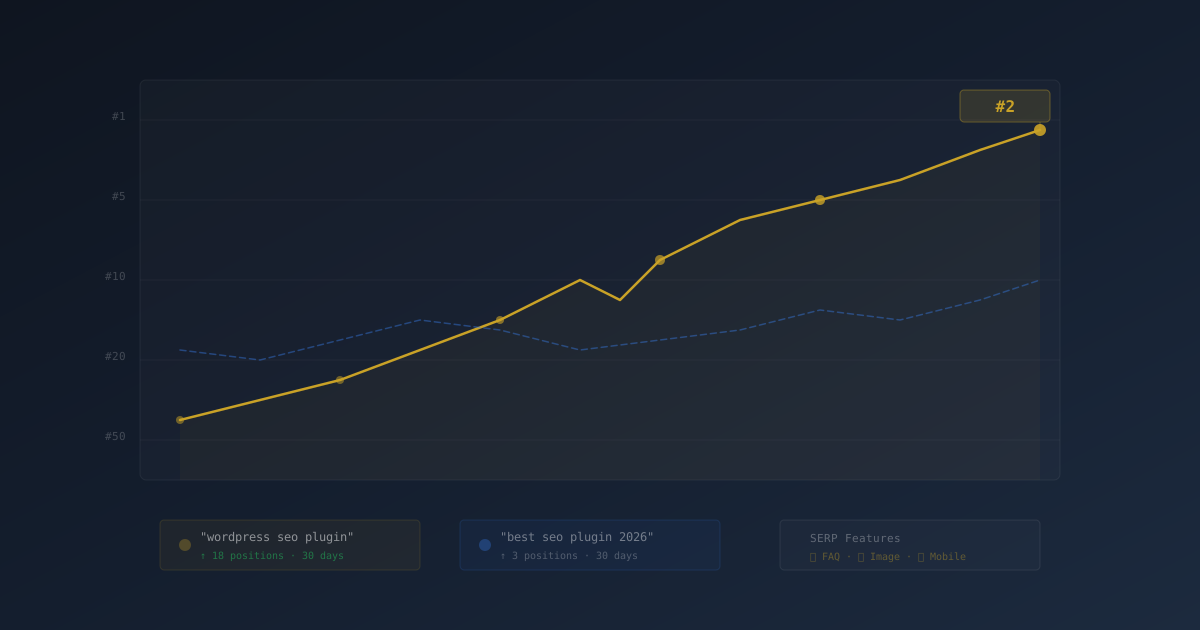
You publish a blog post. It gets some traffic. Then you publish another one. More traffic — or maybe less. You look at Google Analytics and see numbers going up and down, but you have no idea which keywords are driving those visits or whether your positions are improving or decaying.
This is what happens when you run a WordPress site without keyword rank tracking. You are flying blind.
Keyword rank tracking solves this by automatically monitoring where your pages appear in Google's search results for the terms that matter to your business. Instead of guessing, you get hard data: position 4 this week, position 7 last week, position 12 a month ago. Trend lines that tell you whether your SEO work is paying off or falling flat.
Why Tracking Keyword Rankings Matters
Google Search Console shows you impressions and clicks, but it does not tell you your exact ranking position for a specific keyword on a specific day. It averages positions over date ranges, which smooths out the detail you need to make decisions.
A dedicated rank tracker fills that gap. Here is what it enables:
- Measure SEO ROI: You updated a page last Tuesday. Did it move from position 14 to position 6? Without tracking, you will never know.
- Catch ranking drops early: A 5-position drop on a high-traffic keyword can cost thousands in lost revenue. Rank tracking alerts you the day it happens, not weeks later when you notice traffic declining.
- Understand the competitive landscape: See which competitor URLs are ranking for your target keywords and how their positions change over time.
- Prioritize content updates: Keywords sitting at positions 11-20 (page 2) are low-hanging fruit. A content refresh could push them to page 1. Without rank data, you would never identify them.
- Correlate with algorithm updates: When Google rolls out a core update, rank tracking shows you exactly which keywords were affected and by how much.
What a Good Rank Tracker Shows You
Not all rank trackers are equal. The useful ones go beyond a simple position number. Here is what to look for:
Position History Over Time
A line chart showing your ranking for each keyword over weeks and months. This is the most valuable view because SEO is about trends, not snapshots. A keyword that moved from position 30 to position 8 over three months tells a success story that a single position number cannot.
SERP Feature Detection
Google's search results are no longer ten blue links. Featured snippets, People Also Ask boxes, video carousels, local packs, and knowledge panels all compete for clicks. A rank tracker that detects these features helps you understand why a position 1 ranking might still deliver disappointing traffic — if a featured snippet sits above you, it absorbs most of the clicks.
| SERP Feature | Impact on Organic Clicks |
|---|---|
| Featured Snippet | Can reduce position 1 CTR by 50% or more |
| People Also Ask | Pushes organic results down, moderate click impact |
| Local Pack | Dominates for local intent queries |
| Shopping Results | Heavy impact on commercial keywords |
| Video Carousel | Draws attention from text results |
Competitor Tracking
Knowing your own position is half the picture. Seeing which competitor URLs rank for the same keywords — and how their positions shift when yours shift — completes it. If a competitor suddenly jumps from position 8 to position 2 for your primary keyword, you need to investigate what they changed.
Position Change Alerts
Automated notifications when a keyword moves up or down significantly. A drop of 5 or more positions warrants immediate investigation. An improvement of the same magnitude might indicate a content strategy worth repeating.
How to Track Rankings Inside WordPress
Most rank tracking tools are standalone SaaS platforms that have no connection to your WordPress site. You log in to a separate dashboard, manage a separate keyword list, and try to cross-reference data with your CMS manually.
SEObolt takes a different approach. It integrates rank tracking directly into your WordPress workflow through a connected SaaS dashboard. Your keywords, your pages, your content — all in one place.
Step 1: Connect to the Dashboard
After installing SEObolt Pro, navigate to SEObolt > Analytics in your WordPress admin. Click the link to access the SaaS dashboard and select Rank Tracking from the navigation.
Step 2: Add Your Keywords
Click Add Keyword and enter the search query you want to track along with the target URL — the page you expect (or want) to rank for that term. Optional settings include geographic location and device type (desktop or mobile).
Begin with the 10-20 keywords that directly drive revenue or leads. You can always add more later, but starting focused gives you actionable data immediately.
Step 3: Let It Run
SEObolt checks your rankings automatically on a daily schedule. The first check runs within minutes of adding a keyword. After a week, you will have enough data points to see meaningful trends.
What You See in the Dashboard
| Column | What It Tells You |
|---|---|
| Current Position | Where you rank right now (1-100+) |
| Best Position | Your highest-ever ranking for this keyword |
| Average Position | 30-day rolling average, smoothing daily noise |
| Change | Position movement since last check (green = improved, red = declined) |
| SERP Features | Which Google features appear for this keyword |
Which Keywords Should You Track?
Tracking everything is tempting but counterproductive. A focused list of 20-50 keywords gives you enough coverage without drowning in data. Here is how to build that list:
| Category | Examples | Why It Matters |
|---|---|---|
| Brand terms | Your company name, product names | Catch reputation issues early |
| Primary keywords | "best [your product]", "[your service]" | Core revenue-driving terms |
| Long-tail keywords | "how to [solve problem with your product]" | Content performance and topical authority |
| Local keywords | "[service] in [city]" | Local SEO performance (if applicable) |
| Competitor keywords | Terms your competitors rank for but you do not | Identify content gaps and opportunities |
SEObolt's rank tracking is available on the Business tier and above. Business plans support up to 100 tracked keywords; Agency plans support up to 500.
Understanding Your Ranking Data
What Is a "Good" Ranking?
Position matters, but context matters more. Here is how click-through rates typically break down by position:
| Position | Where You Appear | Average CTR |
|---|---|---|
| 1-3 | Top of page 1 | 15-30% |
| 4-10 | Rest of page 1 | 2-8% |
| 11-20 | Page 2 | Less than 2% |
| 21-50 | Pages 3-5 | Near zero |
| 51-100 | Deep results | Essentially invisible |
Daily Fluctuations Are Normal
Google rankings naturally fluctuate by 1-3 positions each day. This is not cause for alarm and does not require action. The signal is in the weekly and monthly trends, not the daily numbers.
Weekly averages trending up = your SEO is working. Weekly averages trending down = time to investigate. A sudden drop of 5+ positions = something changed and warrants immediate attention.
Common Reasons for Ranking Drops
- Google algorithm update: Core updates can reshuffle rankings significantly. Wait 2-4 weeks — positions often recover without intervention.
- Competitor published better content: Someone outranked you with a more comprehensive or more recent page. Time to update yours.
- Technical issues: Crawl errors, deindexed pages, or server downtime. Check Google Search Console immediately.
- Lost backlinks: Key links pointing to your page were removed. Build new ones.
- Content decay: Your page became outdated. Statistics from 2023 do not inspire confidence in 2026. Refresh with current data.
Rank Tracking Best Practices
- Review weekly, not daily. Daily fluctuations are noise. Weekly trends are signal. Set a recurring calendar reminder for a weekly SEO review.
- Always track brand terms. If someone else starts outranking you for your own brand name, you need to know about it immediately.
- Set realistic expectations. Not every keyword will be position 1. Aim for steady improvement over months, not overnight jumps.
- Act on significant drops. A keyword that drops 5+ positions deserves investigation. Do not wait to see if it recovers on its own.
- Refresh declining content. When a keyword's trend line points down over several weeks, update the associated page with fresh information, better structure, and current data.
- Correlate with Google Search Console. Use rank tracking alongside GSC data for the full picture — combine position data with impressions, clicks, and CTR.
- Track desktop and mobile separately. Rankings differ between devices. If your audience is primarily mobile, track mobile positions.
- Document what you change. When you update a page, note the date and what changed. This makes it easy to correlate ranking movements with specific actions.
Why Your Manual Google Search Shows a Different Ranking
This catches nearly everyone off guard. You search for your keyword in Google and see your page at position 3. The rank tracker says position 7. Who is right?
The rank tracker is giving you the more objective answer. Google personalizes your search results based on:
- Your search history and browsing behavior
- Your geographic location (down to city level)
- Whether you are logged into a Google account
- Your device type and screen size
- Time of day and current events
A rank tracker checks from a neutral location without personalization, which is why its data is more reliable for tracking trends over time. If you want a closer manual comparison, search in incognito mode with location services disabled.